


















Originally published in the News-Press by Amy Bennett Williams on February 13, 2026
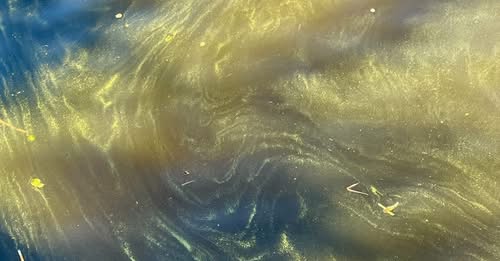
With drought and coldburn browning most of Southwest Florida, the upriver Caloosahatchee is one of the few green places around.
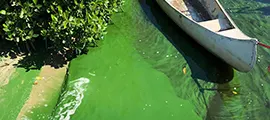
The culprit? Cyanobacteria, AKA blue-green algae, a photosynthesizing microbe that can produce dangerous toxins, including microcystin, which has repeatedly been found in Caloosahatchee samples.
“Microcystin is a potent liver toxin and possible human carcinogen,’ warns the U.S. Environmental Protection Agency. It’s been linked to neurodegenerative disease as well.
Health officials are warning of an algae-contaminated canal in Alva – the second time in the same place since January – and observers report blooms in LaBelle: at the town’s Nature Park and municipal dock, as well as in Moore Haven, close to Lake Okeechobee.
See blue-green algae? Stay away, health officials say
“Harmful blue-green algae toxins (are) in Caloosahatchee River-Sebastian Canal,” the Department of Health in Lee County wrote in a release, and went on to recommend precautions, including not swimming, wading, boating, drinking or even touching water with visible blooms, and washing with soap and water if you do come in contact with algae or even “water that smells unpleasant.”
That goes for pets and livestock, too, some of which have been killed by the stuff.
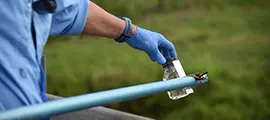
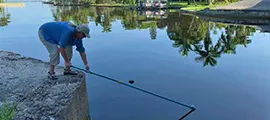
Calusa Waterkeeper board member Jason Pim noted that the Florida Department of Environmental Protection, which does the testing, then sends the results to health departments. It sampled upriver near Moore Haven in Glades County Feb. 5 and in the Alva neighborhood Feb. 9. “Toxicology reports are still pending for both,” he wrote in an email, “but certainly the photos from near Moore Haven look pretty clearly like Microcystis aeruginosa.”
The nonprofit Sanibel-Captiva Conservation Foundation uses strategically placed River, Estuary, and Coastal Observing Network sensors to monitor river conditions.
After being down for repairs, the one in Alva is back online, says SCCF research scientist Rick Bartleson, and its last two samples show a million or more cyanobacteria filaments per liter as well as high chlorophyl levels, which can signal a bloom. Bartleson says he plans to get a sample this week so he can keep track of the bloom.
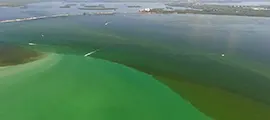
What happens upriver doesn’t always stay upriver: Algae in Hendry or eastern Lee County can eventually affect the estuary and waters around Lee’s barrier islands. That happened in 2018, when a stubborn bloom coupled with lingering red tide hammered the region, with devastating effects on tourism, fishing and real estate.
Blooms often appear in summer, when rain washes contaminants into the river, some of which can fertilize blooms. Dry-season blooms are less common, but have happened in recent years.
Despite rules and plans, state’s pollution fixes ‘trending in the wrong direction’
“The Army Corps has been releasing ‘relatively’ small’ amounts of Lake O water into upper Caloosahatchee all year,” Pim says. But that water’s not enough to meet the required minimum flow and level needed to keep the river’s estuary and its seagrasses healthy. Plus, it’s high in phosphorous and nitrogen, which feed blooms.
“So in some ways we want managers to send us more freshwater from Lake O,” Pim wrote. “The downside being that water is highly polluted in legacy nutrients, if not already supporting an active harmful algae bloom.”
All this points to a larger, harder problem: The river’s pollution isn’t getting any better, which can lead to fingerpointing and fruitless measures to fix it.
“The debate often gets foolishly reduced to whether these harmful algal blooms are being fueled by water from Lake O or other runoff from the Caloosahatchee basin. The answer is likely both. What we do know is that the runoff in these parts of the watershed are overwhelmingly from agricultural lands. We also know the state’s attempts to reduce nutrient loading is failing. It is trending in the wrong direction overall,” Pim said. “With this much nutrient pollution continuing to enter our waters … it should be no surprise that blooms are occurring despite the season.”
Original Story