




















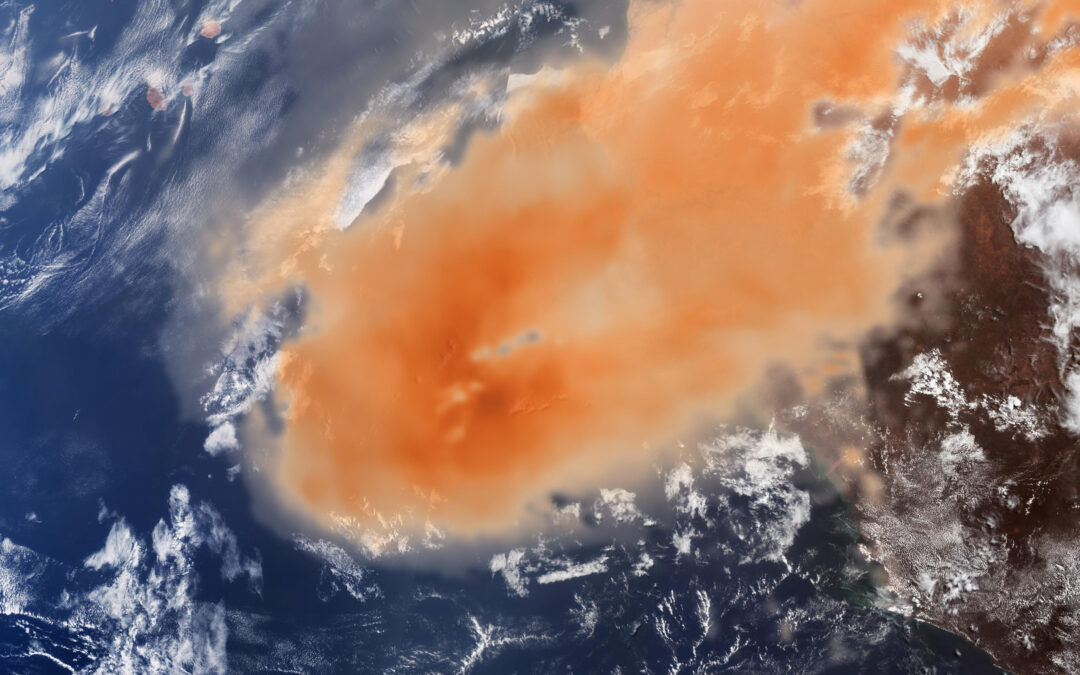
A large plume of Saharan dust approaching Florida is making headlines for hazy skies, colorful sunsets, lower air quality, and its ability to temporarily suppress tropical storm development. But for Calusa Waterkeeper, this dust cloud also raises an important water-quality question: What happens when desert dust traveling thousands of miles across the Atlantic settles into warm coastal waters?
The annual Saharan Air Layer forms over the Sahara Desert and is carried westward across the Atlantic, often reaching Florida during the summer. Most public attention focuses on what the dust does in the atmosphere. Dry, stable air can make conditions less favorable for tropical storms, while suspended dust particles can affect visibility and air quality.
However, there is also an ecological story when that dust reaches the water.
Research published in Proceedings of the National Academy of Sciences found that Saharan dust can deliver iron and other nutrients to marine surface waters, helping promote rapid blooms of Vibrio. The group includes Vibrio vulnificus, the bacterium often referred to in news reports as “flesh-eating bacteria” because it can cause rapidly progressing wound infections. In field observations from the Caribbean and Florida Keys, Vibrio levels increased within about 24 hours after Saharan dust events.
Saharan dust may influence more than bacteria. Iron carried in the dust can also stimulate the growth of Trichodesmium, a marine cyanobacterium that converts atmospheric nitrogen into forms other organisms can use. Research has found Saharan mineral aerosols may help create conditions that fuel the nitrogen economy of red tides in the eastern Gulf of Mexico. Dust alone does not cause red tide, but it may be one of several environmental factors that contribute to its development and persistence.
This does not mean every dust plume will cause unsafe water conditions, and it does not mean the dust is carrying Vibrio or red tide across the ocean. The more careful interpretation is that Saharan dust may “fertilize” bacteria and dinoflagellates already present in warm marine waters.
Saharan dust is not only a story about the sky. It is another example of how closely the atmosphere, ocean, and public health are connected.
As summer water temperatures rise, boaters, anglers, shellfish consumers, and anyone entering coastal waters with cuts or open wounds should stay informed and take reasonable precautions.
For Calusa Waterkeeper and residents of Southwest Florida, this should be a useful reminder that water quality is shaped by more than any single factor. Atmospheric dust, freshwater discharges, nutrient pollution, salinity, water temperature, tides, and weather patterns all interact to influence coastal ecosystems. Understanding those interactions helps scientists better predict changes in water quality and underscores why reducing human sources of pollution remains essential to protecting Southwest Florida’s waters.